I build conversational AI — chatbots and assistants that run on the channels your team already uses, connect to your internal and proprietary systems, and answer from your governed knowledge, with a human in control. I build to ship in production, not slideware.
The value isn’t a generic bot on a web page. It’s an assistant I wire into the systems your work runs on — CRM, databases, document stores, internal knowledge — inside permissions you set, reachable on mobile messaging (such as Telegram or WhatsApp) or your own web app, with human review where it matters.
Proof I ship#
I built and operate KindyWords, a live AI mobile chatbot on Telegram. A photo of handwritten work goes in; it replies with a voice note and a marked-up page, staying inside human-set guardrails. It’s a consumer product, not an enterprise system — but it proves I ship real, running multimodal chatbots, not demos.
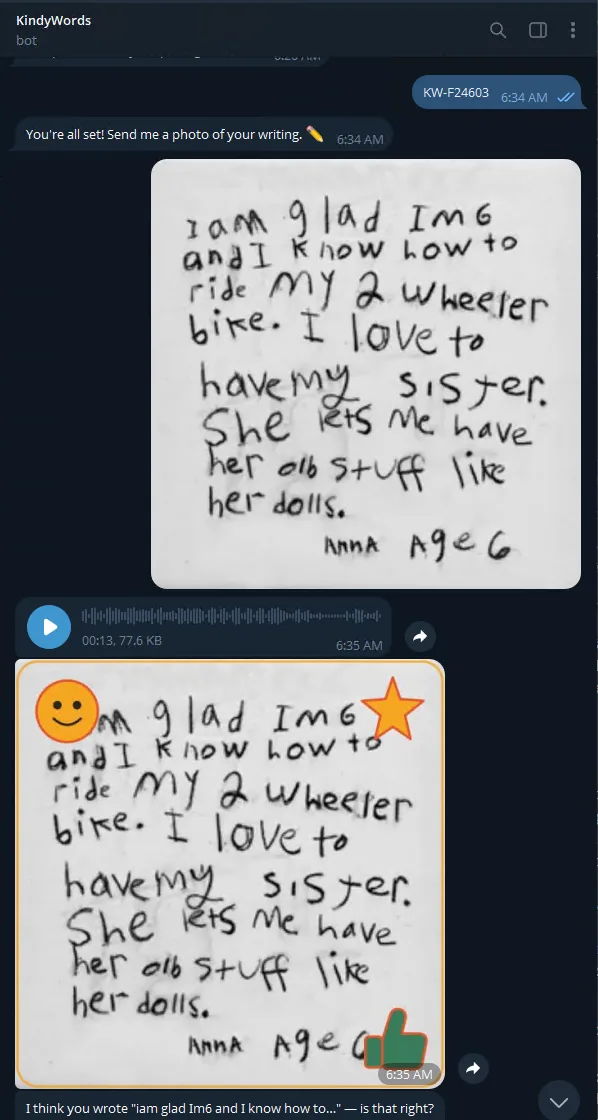
KindyWords proves the delivery — a real bot, live, on a messaging channel. The enterprise integration — your systems, your permissions, your governed knowledge — is the part I build for each client.
Where a governed assistant earns its place#
Advisory, valuation and professional services#
Your firm has already answered this question. Someone worked it out two years ago, nobody can find it now, so it gets worked out again — and the past report that would have backed it is never cited. I wire the assistant into the material your people already rely on: past reports, methodologies, and the working papers behind them, with the source attached and a person in control.
- Past-engagement lookup — “Have we done one like this before, and what did we conclude?” — answered from your own reviewed material, with the source.
- Methodology and sign-off — “Which methodology did we use for this asset class, and who signed it off?”
- Where the work is — “Which engagements are waiting on my review, and who holds the draft?”
- Drafting from approved wording — the approved scope-and-limitations paragraph, instead of copying it out of the last job.
Field and frontline teams#
The other case, and the one most chatbots cannot reach: your data is on-prem, but your people aren’t at their desks. Field, warehouse, and frontline staff can’t get to the ERP from where they actually work. I build a governed assistant on the messaging app they already use that brokers the answer — read-only by default, scoped to each person’s permissions, every query logged, and the data staying on your systems.
Your systems and knowledge — answered where your people are
Your policies, SOPs, and know-how — governed, current, and cited.
Your CRM, ERP, and document stores — read where the data lives.
Only what this person may see
Answers only from your systems and knowledge — it retrieves and cites, it never guesses.
The answer travels — not your data
Trusted and source-backed — in real time, on the channel they already use.
In the field — no desktop, no VPN
Illustrative, not a live chat — a conceptual view of one governed exchange. The assistant reads under each person’s permissions and logs every query, a person approves anything that writes back, and nothing here invents data — it retrieves and cites from your own systems and knowledge, which stay on your systems.
Here’s what I build it to do:
- Real-time ERP lookups from the field — “Stock on hand for part X at warehouse 3?” · “Customer credit status and open invoices?” · “PO status and ETA?” — from the messaging app they already carry, no desktop, no VPN.
- Approvals on the go — a PO, leave request, or expense arrives as a message; approve or reject from your phone, writing back through your workflow.
- Multimodal field capture — staff send a photo or voice note (“delivered 40 units to bay 2, one pallet damaged”); it can be structured, logged, and exceptions flagged for review. Photo intake and voice replies like this already run in my KindyWords bot.
- Frontline SOP and policy answers — “What’s the returns policy for a damaged item over 30 days?” — answered from your governed knowledge, with sources and human review.
- Proactive alerts — low-stock reorder points, overdue receivables, or approvals waiting too long, pushed to the person who owns them.
Each is built to run read-only by default, inside permissions you set, with an audit trail and a human in the loop for anything that writes back. On-prem systems such as SAP, Microsoft Dynamics, NetSuite, or your own database connect through a governed connector I’d build for your environment — your data stays where it is.
Product names are referenced for compatibility and description only, and do not imply partnership, endorsement, or certification by SAP, Microsoft, Oracle, or any third party.
I’m a Microsoft-certified data engineer and MarkLogic Certified Administrator & Developer, and I build these connectors myself — see credentials.
Start with one workflow#

Who you'll talk to
Tao Ling
Founder, Xcelerent · Sydney, Australia
Microsoft-certified data engineer · MarkLogic Certified Administrator & Developer
Value-check one workflow or request a discovery call to talk through where a governed assistant would earn its place.
Common questions#
What kind of AI chatbots does Xcelerent build?
Assistants that run on the channels your team already uses, such as mobile messaging (Telegram or WhatsApp) or your own web app, connect to your systems and answer from your governed knowledge, with a human in control.
Can a chatbot reach on-premise systems such as an ERP?
Yes, through a governed connector built for your environment: read-only by default, scoped to each person's permissions, every query logged, and your data stays where it is. SAP, Microsoft Dynamics, NetSuite or your own database can connect this way.
Has Xcelerent shipped a live chatbot?
Yes. KindyWords is a live AI chatbot on Telegram that Xcelerent built and operates: a photo of handwritten work goes in and it replies with a voice note and a marked-up page. It is a consumer product, not an enterprise system.
How do I start?
Value-check one workflow, or request a free 30-minute discovery call to talk through where a governed assistant would earn its place.